University of Georgia Grade Calculator
UGA’s official grade system stops at A — there is no A+, and A is a flat 4.0 while A- drops a full 0.3 to 3.7. There is also no D+ or D-, so slipping from a C- (1.7) to a D costs you 0.7 grade points, the biggest single jump on the scale. The calculator above uses the registrar’s exact 10-letter table, so what it shows is what Athena will compute.
Two UGA rules catch students off guard: retaking a course never erases the first grade — every attempt counts in your GPA — and there is no elective pass/fail option for regular undergrad courses. Use the calculator to see whether pushing for a B+ instead of a B- is worth it before you commit.
Does your final have several parts (e.g. multiple choice + essay)? Enter each part, then your course info below.
Is your class graded by total points instead of percentages? Enter your points so far.
Enter each category's weight and your score in it. Leave a score blank if it's not graded yet.
🎓 Need your GPA instead? Jump to the University of Georgia GPA calculator (official scale) ↓
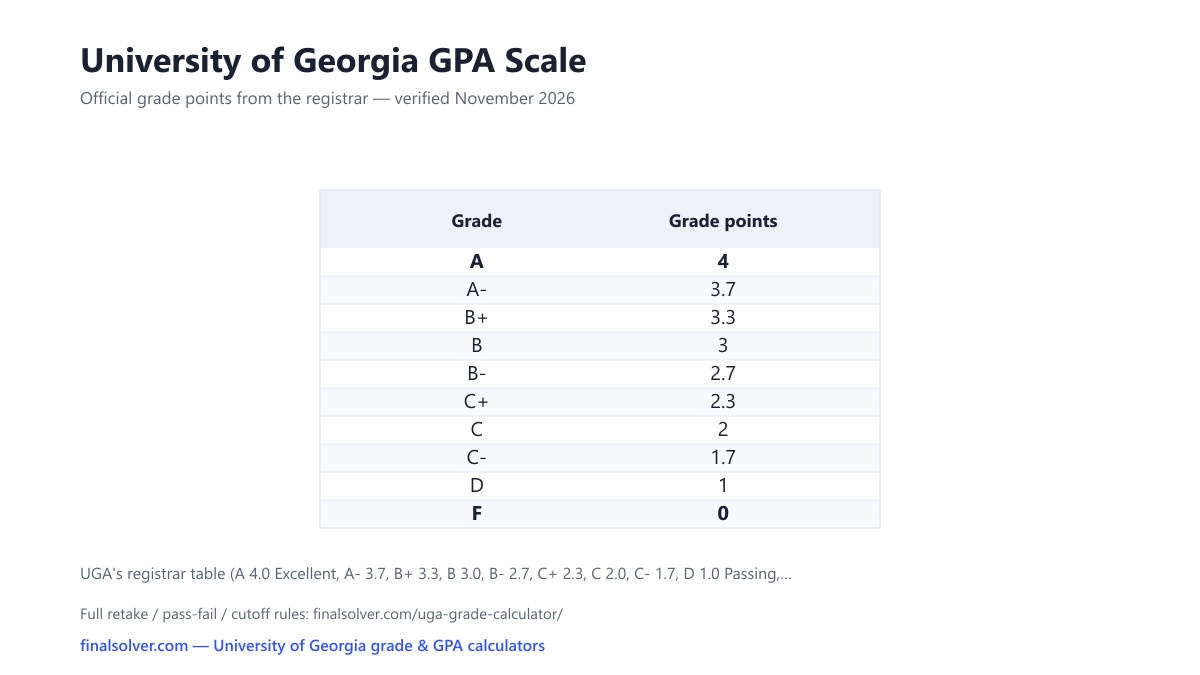
UGA grading scale (official)
| Letter | Grade points |
|---|---|
| A | 4.0 |
| A- | 3.7 |
| B+ | 3.3 |
| B | 3.0 |
| B- | 2.7 |
| C+ | 2.3 |
| C | 2.0 |
| C- | 1.7 |
| D | 1.0 |
| F | 0.0 |
UGA awards no A+, no D+, and no D- — an A is the ceiling at 4.0, and the registrar writes A- as 3.7 (not 3.67). A C- earns credit but will not satisfy requirements that require a C (2.0) or better. W, I, S, U, V, K, NR, NG and WM carry no grade points and are excluded from GPA; an I left unresolved for three semesters automatically becomes an F (or U in an S/U course). UGA publishes no university-wide percentage cutoffs — each instructor converts percentages to letters — and grade point averages are truncated to two decimal points. Source: Grades — UGA Office of the Registrar, checked 2026-11-01.
Retakes always count — UGA has no grade replacement
Under UGA’s Repeating a Course policy, if you retake a course you already have credit for, the grade from every attempt is included in your cumulative and overall GPA — nothing is replaced or forgiven. You earn credit only once, the credit from your highest grade is what satisfies the degree requirement, all grades stay on your transcript, and the course is flagged as repeated. Financial aid adds a cap: a previously passed course can generally be repeated only once and still count toward aid enrollment.
There is no elective pass/fail option for regular UGA undergraduate courses. S and U marks exist only for courses designated S/U — mostly professional, seminar, or graduate-level courses — and neither affects your GPA: S earns credit hours, U earns none.
How the other camp does it: at Georgia State, an approved repeat-to-replace swaps the earlier grade — the same retaken C yields a different GPA outcome entirely. Georgia State retake rules →
What do you need on your final?
Needed = (target − current × (1 − weight)) ÷ weight, where weight is your final’s share of the course grade as a decimal. Say you are sitting on a 75 overall, your final is worth 40% of the grade, and you want to finish at an 80: (80 − 75 × 0.6) ÷ 0.4 = (80 − 45) ÷ 0.4 = 35 ÷ 0.4 = 87.5% on the final. UGA’s 0.3-point steps make the B/B- boundary (3.0 vs 2.7) worth real money, so check the exact percentage your instructor assigns to each letter band in the syllabus. Remember the registrar truncates rather than rounds GPAs at two decimals, so a 3.999 semester prints as 3.99.
University of Georgia: GPA credits example
Your University of Georgia GPA is a credit-weighted average: (credits × grade points) summed ÷ total credits. Worked example on the official University of Georgia scale: A (4) × 3 credits + B+ (3.3) × 4 credits + A- (3.7) × 3 credits = 36.3 points over 10 credits → GPA 3.63. UGA's registrar table (A 4.0 Excellent, A- 3.7, B+ 3.3, B 3.0, B- 2.7, C+ 2.3, C 2.0, C- 1.7, D 1.0 Passing, F 0.0) has NO A+ — an A is the top grade at a flat 4.0 — and NO D+ or D-, so the gap from C- (1.7) to D (1.0) is 0.7 points and D to F is a full 1.0. The calculator at the bottom of this page runs this exact table.
Three finals scenarios students actually ask
Static answers, checkable against the calculator above — the three setups that show up every December and May (pass line shown for a typical 70% D; your school's line is in the scale above):
| You sit at | Final worth | For a B− (80%) | To pass (70%) |
|---|---|---|---|
| 85% | 20% | 60% — makeable | 10% — already safe |
| 78% | 40% | 83% — study weekend | 58% — very makeable |
| 60% (bombed the midterm; 30% coursework at 100%) | 40% | 80% — a real but winnable fight | 55% — still passable |
University of Georgia GPA calculator — official scale
Runs this school's exact grade-point table — not a generic 4.0 rounding.
Computed on this school's official grade-point table shown above — no rounding adjustments needed.
Frequently Asked Questions
Is there an A+ at UGA?
No. UGA’s official grade system tops out at A = 4.0; there is no A+, no D+, and no D-. The full letter-graded scale is A, A-, B+, B, B-, C+, C, C-, D, F, and the registrar lists A- as exactly 3.7 grade points.
Can I replace a grade at UGA?
No. UGA has no grade replacement or forgiveness: when you repeat a course, the grade from each attempt stays in your cumulative and overall GPA. You only earn credit once, the highest grade’s credit is used to satisfy degree requirements, and the transcript shows every attempt plus a repeated-course designation.
What GPA is an A at UGA?
An A is 4.0 grade points — the highest value on UGA’s scale. An A- is 3.7, a B+ is 3.3, and each letter step down subtracts 0.3 until C- at 1.7; D is 1.0 and F is 0.0.
Does UGA round grades?
UGA truncates grade point averages to two decimal points rather than rounding them — a computed 3.999 is recorded as 3.99. How course percentages get rounded before a letter is assigned is up to each instructor; UGA publishes no university-wide percentage cutoffs.
How does pass/fail work at UGA?
There is no elective pass/fail choice for regular undergraduate courses. S (Satisfactory) and U (Unsatisfactory) are used only in courses designated S/U, typically professional, seminar, or graduate-level: S earns credit hours, U earns none, and neither is included in your GPA. An incomplete (I) in an S/U course becomes a U if not resolved within three semesters.
Can I use the GPA calculator on this site for UGA?
Yes — the calculator on this page runs University of Georgia's official grade-point table exactly. Weight credits as shown in the "GPA: how the points add up" section below; the general calculator elsewhere on the site uses standard rounding if you ever need a plain 4.0 number.
Does a W look bad when I apply to grad school?
One or two Ws read as scheduling realism, not an ability signal — committees weigh trends and course rigor. A pattern of many Ws invites questions, and a W followed by retaking the course (and acing it) often tells a better story than the C you would have survived.
Can I retake a class I got a C in just to boost my GPA?
You can, but run the numbers first: at UGA, the grade earned each time a course is taken counts. A C retaken for an A pulls the GPA weight of that course to roughly the midpoint — a real but partial gain, rarely worth full tuition. Check the policy above for any forgiveness carve-out before deciding.
More calculators
Compare with other schools
Grading rules vary wildly — University of Georgia vs other schools with different systems: