University of California, Riverside Grade Calculator
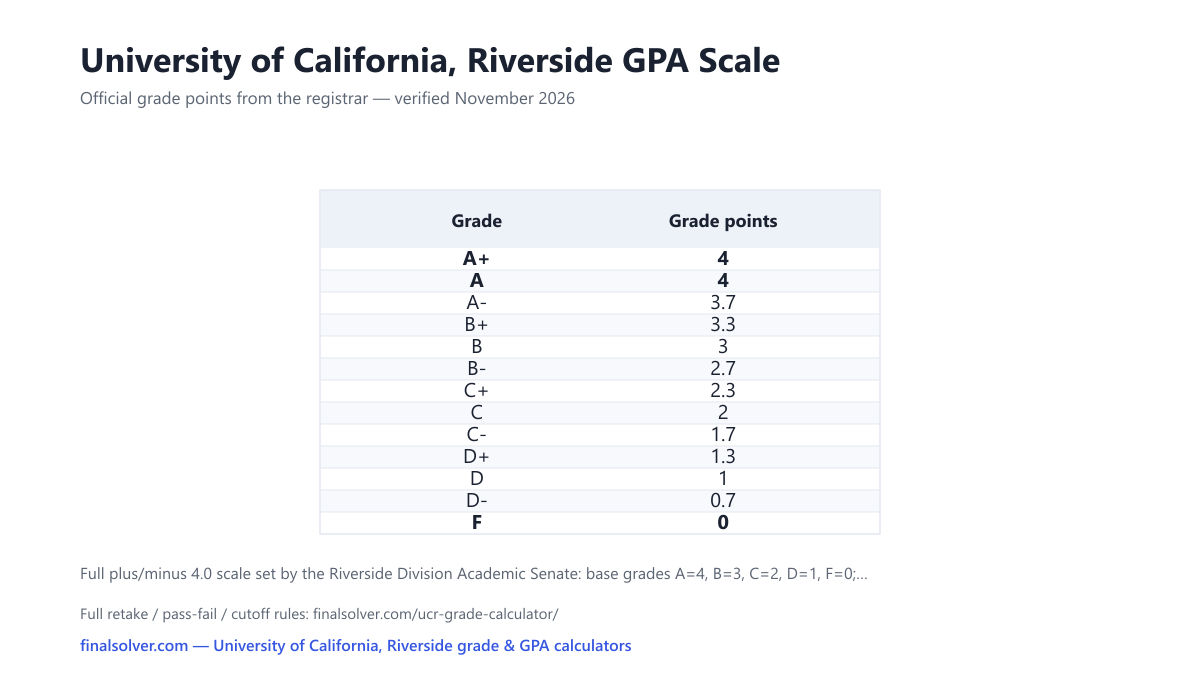
UC Riverside’s Academic Senate writes the scale as pure arithmetic: base grades A=4, B=3, C=2, D=1, F=0, and plus grades add 0.3 while minus grades subtract 0.3 — except A+, which stays at 4.0, identical to an A. So the ladder runs A 4.0, A- 3.7, B+ 3.3, all the way down to a D- at 0.7. Enter your current grade and final weight above.
The repeat list at UCR is short: only D, F or NC grades can be repeated, the most recently earned grade is the one computed in your GPA, and the replacement treatment stops after 16 repeat units.
Does your final have several parts (e.g. multiple choice + essay)? Enter each part, then your course info below.
Is your class graded by total points instead of percentages? Enter your points so far.
Enter each category's weight and your score in it. Leave a score blank if it's not graded yet.
🎓 Need your GPA instead? Jump to the University of California, Riverside GPA calculator (official scale) ↓
UC Riverside grading scale (official)
| Letter | Grade points |
|---|---|
| A+ | 4.00 |
| A | 4.00 |
| A- | 3.70 |
| B+ | 3.30 |
| B | 3.00 |
| B- | 2.70 |
| C+ | 2.30 |
| C | 2.00 |
| C- | 1.70 |
| D+ | 1.30 |
| D | 1.00 |
| D- | 0.70 |
| F | 0.00 |
The scale is set by regulation of the Riverside Division of the Academic Senate (R1.1.1): base grades plus exactly 0.3 for a plus and minus 0.3 for a minus — with the single exception that A+ carries 4.0, the same as A, marking only “extraordinary achievement.” Under S/NC (satisfactory/no credit), an S requires 2.0-level work or better for undergraduates and awards unit credit but no grade points. Source: UC Riverside Academic Senate — Regulations, Section 1, checked 2026-11-11.
Repeating courses at UC Riverside: newest grade, 16-unit cap
Only courses graded D, F or NC may be repeated — anything C- or better is off the table — and repeating a course more than once requires Dean approval. All attempts stay on the transcript, but only the most recently earned grade is computed in the GPA. Per UC systemwide regulation, that repeat-with-replacement treatment is capped at 16 repeat units; beyond the cap, grades are averaged instead of replaced.
“Newest grade counts” cuts both ways: if you retake an F and earn another F (or a D when you had a D), the newer, possibly worse grade is the one computed — so retake only when you can genuinely change the outcome. The S/NC election interacts with this too: an NC never touched your GPA, but it did cost the credit, and a retake for a letter grade is your one chance to bank real points from that course. Budget the 16 units — roughly four 4-unit courses — across your whole degree.
What do you need on your final?
Needed = (target − current × (1 − weight)) ÷ weight, where “weight” is your final’s share of the course grade as a decimal. Example: sitting at a 68% with a final worth 40% of the grade and wanting a 70% overall, you need (70 − 68 × 0.6) ÷ 0.4 = (70 − 40.8) ÷ 0.4 = 29.2 ÷ 0.4 = 73% on the final.
If you took the course S/NC, remember the bar sits at 2.0-level (C) work: a C-minus performance that would still squeak by on the letter ladder earns nothing under S/NC. On the letter side, a D at 1.0 is passing credit — the only full cliff is D- 0.7 down to F 0.0.
University of California, Riverside: GPA credits example
Your University of California, Riverside GPA is a credit-weighted average: (credits × grade points) summed ÷ total credits. Worked example on the official UC Riverside scale: A- (3.7) × 3 credits + B+ (3.3) × 3 credits + C+ (2.3) × 4 credits = 30.2 points over 10 credits → GPA 3.02. UCR’s Senate formula makes every plus/minus step an exact 0.3 (A+ alone is pinned to 4.0), and an S under the S/NC option contributes credits but zero points. The calculator at the bottom of this page runs this exact table.
Three finals scenarios students actually ask
Static answers, checkable against the calculator above — the three setups that show up every December and May (pass line shown for a typical 70% D; your school's line is in the scale above):
| You sit at | Final worth | For a B− (80%) | To pass (70%) |
|---|---|---|---|
| 85% | 20% | 60% — makeable | 10% — already safe |
| 78% | 40% | 83% — study weekend | 58% — very makeable |
| 60% (bombed the midterm; 30% coursework at 100%) | 40% | 80% — a real but winnable fight | 55% — still passable |
University of California, Riverside GPA calculator — official scale
Runs this school's exact grade-point table — not a generic 4.0 rounding.
Computed on this school's official grade-point table shown above — no rounding adjustments needed.
Frequently Asked Questions
Can I retake a C to raise my GPA at UC Riverside?
No. Only courses graded D, F or NC may be repeated at UCR — C-level work or better is locked in for good, so there is no grade-improvement retake to be had.
Which grade counts when I repeat a course at UCR?
The most recently earned grade is the one computed in your GPA — for better or worse. Every attempt stays on the transcript, and the replacement treatment is capped at 16 repeat units under UC systemwide regulation, after which grades average.
What does S/NC mean at UC Riverside?
Satisfactory/No Credit. For undergraduates an S requires 2.0-level (C) work or better; S awards unit credit and NC awards nothing, and neither carries grade points or enters your GPA.
Is an A+ worth more than 4.0 at UCR?
No. The Senate regulation pins A+ at 4.0 — the same as A — even though every other plus grade adds 0.3. A+ only marks “extraordinary achievement.”
Does a W look bad when I apply to grad school?
One or two Ws read as scheduling realism, not an ability signal — committees weigh trends and course rigor. A pattern of many Ws invites questions, and a W followed by retaking the course (and acing it) often tells a better story than the C you would have survived.
Can I retake a class I got a C in just to boost my GPA?
Not usually the door it looks like: at UCR, only D/F/NC grades may be repeated — so the C you survived is likely staying. Confirm the exact cutoff in the retake policy above before paying for anything; the cheaper move is usually banking a strong grade in your next course instead of re-buying one you already passed.