University of California, Irvine Grade Calculator
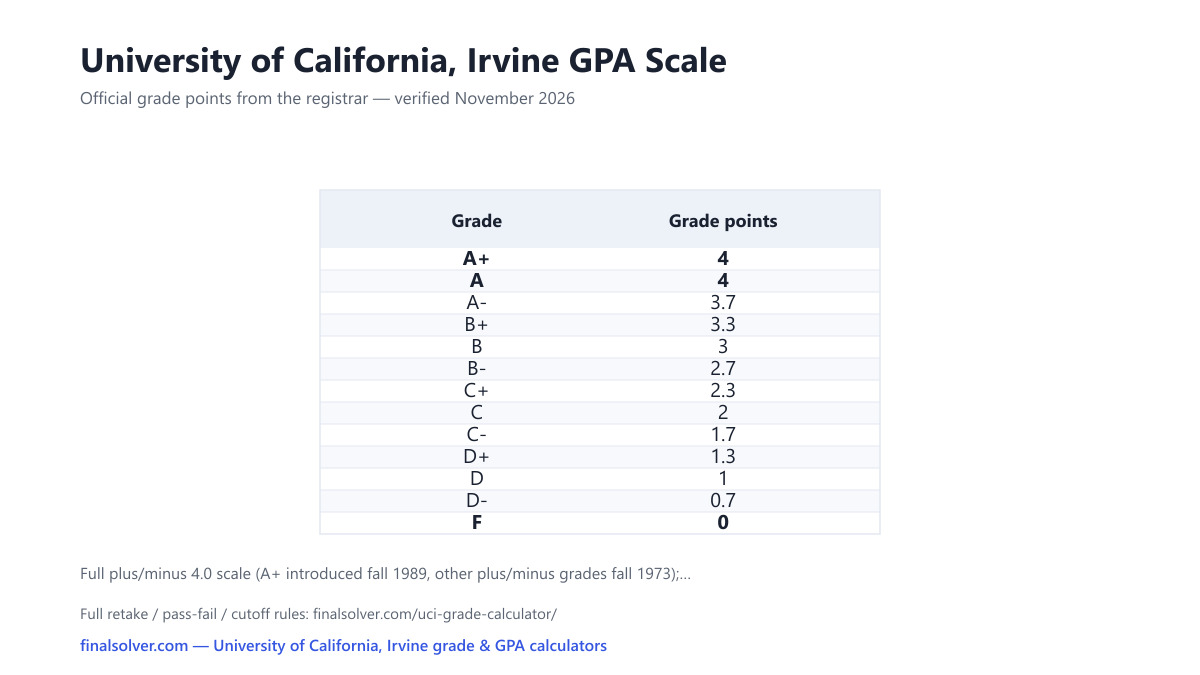
UC Irvine keeps the complete plus/minus ladder — every grade from A+ down to D- exists, and a D- still earns 0.7 points — while the top stays flat: A+ counts 4.0, the same as A. The scale has been plus/minus since 1973 (A+ only arrived in fall 1989). Enter your current grade and final weight above.
UCI’s repeat window is one of the friendlier ones in the UC system: undergraduates may repeat any course graded C- or lower — including D+, D, D-, F and NP — and the first 16 repeat units are grade-replaced; after that, both grades average in.
Does your final have several parts (e.g. multiple choice + essay)? Enter each part, then your course info below.
Is your class graded by total points instead of percentages? Enter your points so far.
Enter each category's weight and your score in it. Leave a score blank if it's not graded yet.
🎓 Need your GPA instead? Jump to the University of California, Irvine GPA calculator (official scale) ↓
UC Irvine grading scale (official)
| Letter | Grade points |
|---|---|
| A+ | 4.00 |
| A | 4.00 |
| A- | 3.70 |
| B+ | 3.30 |
| B | 3.00 |
| B- | 2.70 |
| C+ | 2.30 |
| C | 2.00 |
| C- | 1.70 |
| D+ | 1.30 |
| D | 1.00 |
| D- | 0.70 |
| F | 0.00 |
UC Irvine runs the full plus/minus ladder from A+ to D- (the other plus/minus grades arrived in fall 1973, A+ in fall 1989), but A+ earns the same 4.0 as an A. Under the pass/no pass option, P equals C- or better work and NP equals D+ or lower (definitions effective Fall 2023); P and NP carry no grade points and never touch your GPA. Source: UCI Registrar — Transcript Notations, checked 2026-11-11.
Repeating courses at UC Irvine: the 16-unit replacement window
Undergraduates may repeat courses graded C- or lower — D+, D, D-, F and NP all qualify, which is more generous than most UC campuses — and a course originally taken for a letter grade must be repeated for a letter grade. Grade replacement applies only to the first 16 units of repeated coursework: within that budget the new grade replaces the old one in your GPA. Repeats beyond 16 units have both grades averaged in, and every attempt remains on the transcript.
Because UCI lets you retake a C-, this is one of the few schools where a mediocre (not failed) grade can genuinely be swapped out — but only within the 16-unit budget, roughly four 4-unit courses. Sequence your repeats so the courses that drag your GPA most go first; a retake past the budget averages both attempts, so a small improvement can still net out negative if the first grade was bad enough.
What do you need on your final?
Needed = (target − current × (1 − weight)) ÷ weight, where “weight” is your final’s share of the course grade as a decimal. Example: sitting at an 85% with a final worth 20% of the grade and wanting an 87% overall, you need (87 − 85 × 0.8) ÷ 0.2 = (87 − 68) ÷ 0.2 = 19 ÷ 0.2 = 95% on the final.
If the course is pass/no pass, the C- line is all-or-nothing: a P requires C- or better work, so finishing one notch below the boundary records NP — no credit, though also no GPA damage. On the letter ladder, every rung (C to C-, B+ to A-) is worth a steady 0.3–0.4 points, so there are no cliffs except the D- to F drop from 0.7 to 0.
University of California, Irvine: GPA credits example
Your University of California, Irvine GPA is a credit-weighted average: (credits × grade points) summed ÷ total credits. Worked example on the official UC Irvine scale: A- (3.7) × 3 credits + A (4) × 4 credits + B+ (3.3) × 3 credits = 37 points over 10 credits → GPA 3.70. UCI keeps the entire plus/minus ladder down to D- (0.7), while A+ banks the same 4.0 as A — and repeats down to a C- can be grade-replaced within the first 16 units. The calculator at the bottom of this page runs this exact table.
Three finals scenarios students actually ask
Static answers, checkable against the calculator above — the three setups that show up every December and May (pass line shown for a typical 70% D; your school's line is in the scale above):
| You sit at | Final worth | For a B− (80%) | To pass (70%) |
|---|---|---|---|
| 85% | 20% | 60% — makeable | 10% — already safe |
| 78% | 40% | 83% — study weekend | 58% — very makeable |
| 60% (bombed the midterm; 30% coursework at 100%) | 40% | 80% — a real but winnable fight | 55% — still passable |
University of California, Irvine GPA calculator — official scale
Runs this school's exact grade-point table — not a generic 4.0 rounding.
Computed on this school's official grade-point table shown above — no rounding adjustments needed.
Frequently Asked Questions
Can I retake a class I got a C- in at UC Irvine?
Yes — UCI lets undergraduates repeat any course graded C- or lower, which is more generous than most UC campuses (they typically stop at D/F). The grade replacement applies only within your first 16 repeat units.
Does A+ count more than A at UCI?
No, both are 4.0 grade points. A+ was introduced in fall 1989 (the other plus/minus grades in fall 1973) and has always carried the same value as A.
What does NP mean at UC Irvine?
No Pass: work at the D+ level or lower under the pass/no pass option (P is C- or better, definitions effective Fall 2023). Neither P nor NP carries grade points or enters your GPA; NP simply awards no credit.
How many units of grade replacement do I get at UCI?
Sixteen. The first 16 units of repeated coursework are grade-replaced (new grade in, old grade out of the GPA); repeats beyond that average both attempts, and letter-grade courses must be repeated for a letter grade.
Does a W look bad when I apply to grad school?
One or two Ws read as scheduling realism, not an ability signal — committees weigh trends and course rigor. A pattern of many Ws invites questions, and a W followed by retaking the course (and acing it) often tells a better story than the C you would have survived.
Can I retake a class I got a C in just to boost my GPA?
Not usually the door it looks like: at UCI, repeats are limited to C- or lower grades — so the C you survived is likely staying. Confirm the exact cutoff in the retake policy above before paying for anything; the cheaper move is usually banking a strong grade in your next course instead of re-buying one you already passed.