Temple University Grade Calculator
Temple runs the full plus/minus ladder in exact thirds — A- 3.67, B+ 3.33, C+ 2.33, all the way down to D- 0.67 — with a complete D range, but no A+: a flat A at 4.00 is the ceiling. Plug in your current grade and final weight above.
Temple lets you attempt a course up to 3 times (the third needs dean approval), and when you repeat, only the highest grade counts in your GPA — all attempts stay on the transcript and credit is earned once.
Does your final have several parts (e.g. multiple choice + essay)? Enter each part, then your course info below.
Is your class graded by total points instead of percentages? Enter your points so far.
Enter each category's weight and your score in it. Leave a score blank if it's not graded yet.
🎓 Need your GPA instead? Jump to the Temple University GPA calculator (official scale) ↓
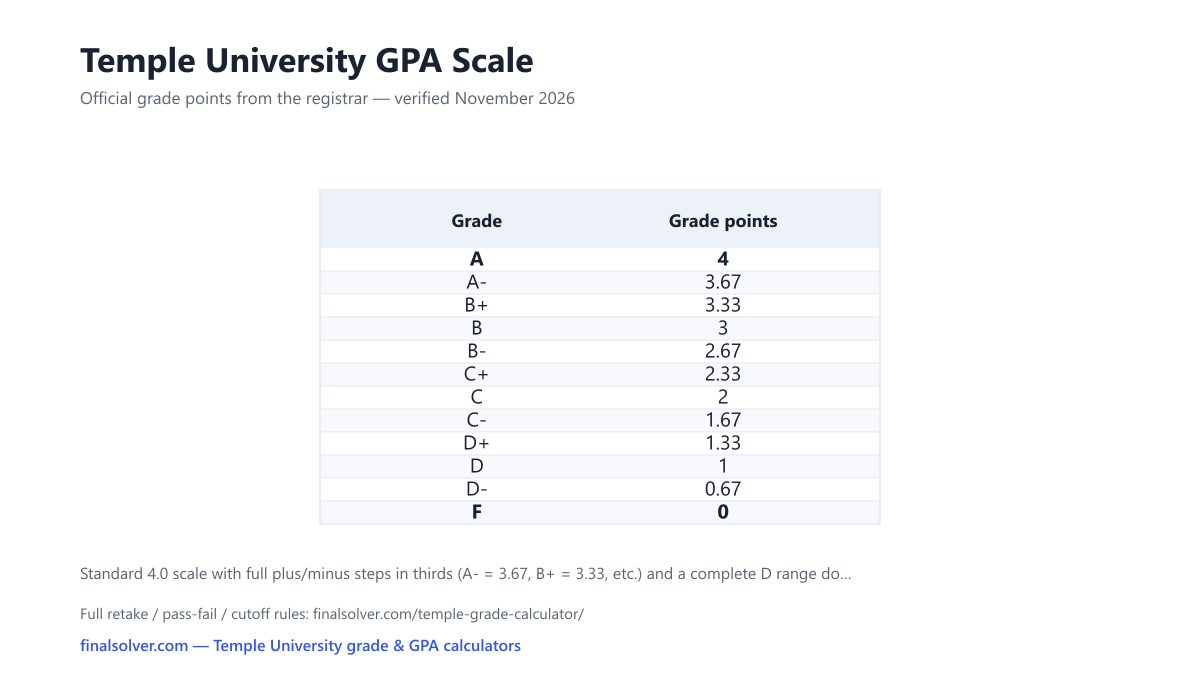
Temple grading scale (official)
| Letter | Grade points |
|---|---|
| A | 4.00 |
| A- | 3.67 |
| B+ | 3.33 |
| B | 3.00 |
| B- | 2.67 |
| C+ | 2.33 |
| C | 2.00 |
| C- | 1.67 |
| D+ | 1.33 |
| D | 1.00 |
| D- | 0.67 |
| F | 0.00 |
Temple steps in thirds, not tenths: A- = 3.67, B+ = 3.33, B- = 2.67, C+ = 2.33, C- = 1.67, D+ = 1.33, D- = 0.67. The D range is complete down to D- (0.67), but there is no A+ — A at 4.00 is the top grade. Temple publishes grade points, not percentage cutoffs — your syllabus sets the bands. Source: Temple Bulletin 2026-2027 — Grades and Grading, checked 2026-11-11.
Temple repeats: 3 attempts, highest grade counts
A Temple course may be attempted up to 3 times, and the third attempt requires dean approval. All attempts stay on the transcript, but only the highest grade counts in the GPA and credit is earned only once. Source: Temple Bulletin — Repeating a Course (Policy 02.10.12), checked 2026-11-11.
Because Temple keeps the highest grade rather than the most recent, a repeat is close to risk-free for your GPA: even a weaker second attempt cannot drag the first one down. Budget your attempts carefully — the cap is per course, and burning one on a marginal C-to-B upgrade leaves fewer shots at a course you might actually need to rescue later.
What do you need on your final?
Needed = (target − current × (1 − weight)) ÷ weight, where “weight” is your final’s share of the course grade as a decimal. Example: sitting at 73% with a final worth 30% of the grade and targeting 77%, you need (77 − 73 × 0.7) ÷ 0.3 = (77 − 51.1) ÷ 0.3 = 25.9 ÷ 0.3 ≈ 86.3% on the final.
Temple’s twist: every step is a third of a point and the ladder reaches all the way to D- (0.67), so boundaries are dense — crossing C to C+ is worth 0.33 points, while slipping from D- to F costs 0.67 — and there is no A+ above A (4.00) no matter how high you finish.
Temple University: GPA credits example
Your Temple University GPA is a credit-weighted average: (credits × grade points) summed ÷ total credits. Worked example on the official Temple scale: A (4.00) × 3 credits + B+ (3.33) × 3 credits + A- (3.67) × 4 credits = 12.00 + 9.99 + 14.68 = 36.67 points over 10 credits → GPA 3.67. Temple's steps are exact thirds (3.67 / 3.33 / 2.67 / 2.33 / 1.67 / 1.33 / 0.67) rather than the tenths used elsewhere, the D range is complete down to D-, and there is no A+. The calculator at the bottom of this page runs this exact table.
Three finals scenarios students actually ask
Static answers, checkable against the calculator above — the three setups that show up every December and May (pass line shown for a typical 70% D; your school's line is in the scale above):
| You sit at | Final worth | For a B− (80%) | To pass (70%) |
|---|---|---|---|
| 85% | 20% | 60% — makeable | 10% — already safe |
| 78% | 40% | 83% — study weekend | 58% — very makeable |
| 60% (bombed the midterm; 30% coursework at 100%) | 40% | 80% — a real but winnable fight | 55% — still passable |
Temple University GPA calculator — official scale
Runs this school's exact grade-point table — not a generic 4.0 rounding.
Computed on this school's official grade-point table shown above — no rounding adjustments needed.
Frequently Asked Questions
What is an A- at Temple in grade points?
3.67. Temple’s plus/minus steps are thirds: A- 3.67, B+ 3.33, B- 2.67, C+ 2.33, C- 1.67, D+ 1.33, D- 0.67 — not the 3.7/3.3 tenths used at many schools.
Does Temple have an A+?
No. Temple’s grading table tops out at A = 4.00; there is no A+ row, so perfect work earns the same 4.00 as any A.
How many times can I retake a course at Temple?
Up to 3 attempts, and the third attempt needs dean approval. All attempts stay on your transcript, but only the highest grade counts in your GPA; credit is earned only once.
What is the lowest grade on Temple’s scale?
D- at 0.67 grade points — Temple keeps a complete D range (D+ 1.33, D 1.00, D- 0.67) below the C band, then F at 0.00.
Does a W look bad when I apply to grad school?
One or two Ws read as scheduling realism, not an ability signal — committees weigh trends and course rigor. A pattern of many Ws invites questions, and a W followed by retaking the course (and acing it) often tells a better story than the C you would have survived.
Can I retake a class I got a C in just to boost my GPA?
Yes — and the math is strongly in your favor: at Temple, only the highest grade counts in the GPA. Retake the C and score an A and the A is effectively what your GPA sees. Two honest caveats: the original grade usually stays on the transcript for grad-school eyes, and the caps in the policy above (units or attempts) are real.