Purdue Grade Calculator
Purdue's scale has a grade most schools don't: the E — conditional failure, which can be repaired to a D within one semester without retaking the course. It counts 0.0 like an F until you fix it. Know which one you're facing before you plan finals week.
The good news for retakes: Purdue replaces — only your most recent attempt counts in your cumulative GPA (up to three attempts per non-repeatable course). And like everywhere on this page, percentage cutoffs are officially nobody's business but your syllabus's.
Does your final have several parts (e.g. multiple choice + essay)? Enter each part, then your course info below.
Is your class graded by total points instead of percentages? Enter your points so far.
Enter each category's weight and your score in it. Leave a score blank if it's not graded yet.
🎓 Need your GPA instead? Jump to the Purdue GPA calculator (official scale) ↓
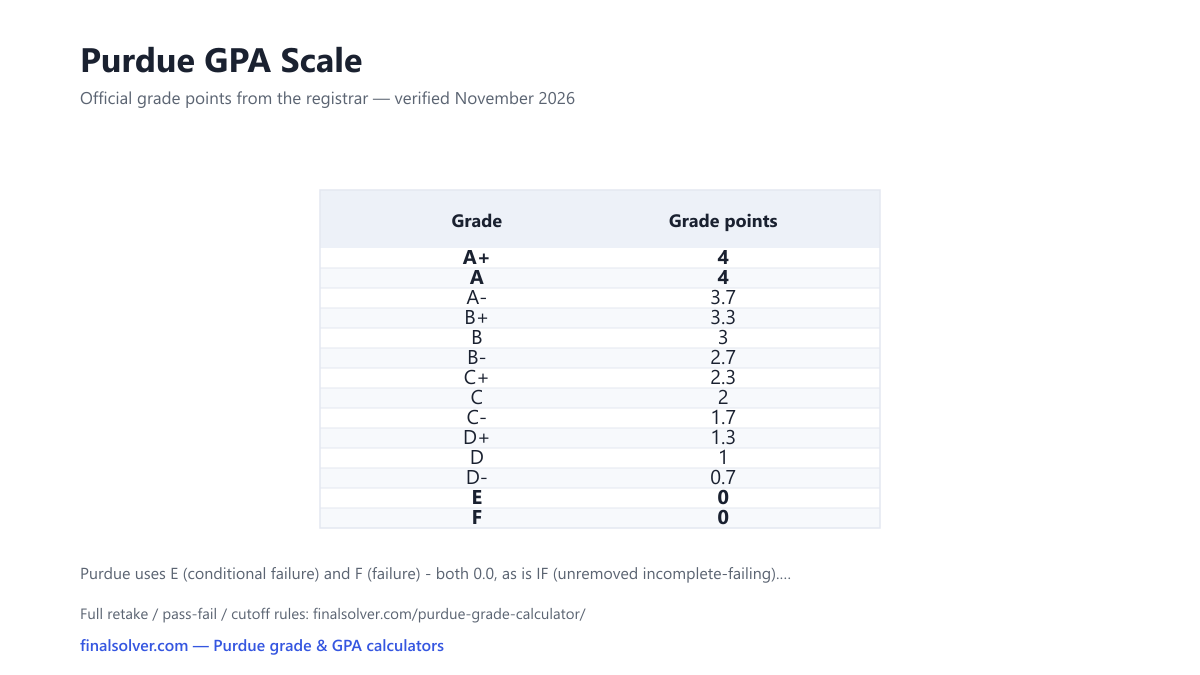
Purdue grading scale (official 4.0)
| Letter | Grade points |
|---|---|
| A+ / A | 4.0 |
| A− | 3.7 |
| B+ | 3.3 |
| B | 3.0 |
| B− | 2.7 |
| C+ | 2.3 |
| C | 2.0 |
| C− | 1.7 |
| D+ | 1.3 |
| D | 1.0 |
| D− | 0.7 |
| E / F | 0.0 |
E = conditional failure (repairable to D within one semester, without repeating); F = failure (course must be repeated). Both count 0.0, as does an unremoved IF. No official percentage cutoffs or rounding policy — the catalog's "Basis of Grades" leaves both to instructors. Source: Purdue Catalog, Academic Regulations J, checked 2026-10-06.
Retakes and Pass/Not-Pass at Purdue
Retake math is unusually forgiving here: with advisor guidance you may take a non-repeatable course up to three times, same course and grade mode, and only the most recent grade counts in cumulative GPA. (Transfer credit can't erase Purdue grades.) Separately, an E can convert to a D by exam/requirements within one semester — the D replaces the E in future GPAs. Pass/Not-Pass: P covers A+ through C− level work, never enters GPA, and is capped at 20% of the credit hours required for your degree.
How the other camp does it: at Illinois, both attempts count by default (a 4-course replacement option exists) — the same retaken C yields a different GPA outcome entirely. Illinois retake rules →
What do you need on your final?
Needed = (target − current × (1 − weight)) ÷ weight. The Purdue twist: because an E can sometimes be repaired, "what's the minimum to not-F" and "what do I need for my target letter" are two different questions — run both above and study to the one that matters.
Purdue: GPA credits example
Your Purdue GPA is a credit-weighted average: (credits × grade points) summed ÷ total credits. Worked example on the official Purdue scale: A+ (4) × 3 credits + B+ (3.3) × 4 credits + A- (3.7) × 3 credits = 36.3 points over 10 credits → GPA 3.63. Purdue uses E (conditional failure) and F (failure) - both 0.0, as is IF (unremoved incomplete-failing). The calculator at the bottom of this page runs this exact table.
Three finals scenarios students actually ask
Static answers, checkable against the calculator above — the three setups that show up every December and May (pass line shown for a typical 70% D; your school's line is in the scale above):
| You sit at | Final worth | For a B− (80%) | To pass (70%) |
|---|---|---|---|
| 85% | 20% | 60% — makeable | 10% — already safe |
| 78% | 40% | 83% — study weekend | 58% — very makeable |
| 60% (bombed the midterm; 30% coursework at 100%) | 40% | 80% — a real but winnable fight | 55% — still passable |
Purdue GPA calculator — official scale
Runs this school's exact grade-point table — not a generic 4.0 rounding.
Computed on this school's official grade-point table shown above — no rounding adjustments needed.
Frequently Asked Questions
What is an E grade at Purdue?
Conditional failure — worth 0.0, but improvable: you can raise an E to a D (by examination or completing requirements) within one semester without repeating the course, and the D then replaces the E in GPA calculations. A plain F requires repeating the course.
What GPA is an A at Purdue?
A = 4.0, same as A+ (no bonus for A+). A− = 3.7, B+ = 3.3, and so on down to D− = 0.7 — full table above from the official catalog.
Does Purdue replace grades if I retake a course?
Yes — for the cumulative GPA, only the most recent of up to three attempts counts (advisor guidance required, same course and grade mode). Both attempts remain on your transcript; transfer credit cannot remove Purdue grades from GPA.
Does Purdue round grades?
No official rounding policy exists in the catalog's grading regulations — it's instructor discretion. Your syllabus, not a university rule, decides whether 89.5 becomes an A− or a B+.
How does Pass/Not-Pass work at Purdue?
P replaces a letter grade for work at C− level or better and is excluded from GPA; below that you get N. Caps: P/N can't exceed 20% of the credit hours needed to graduate, and only applies to courses not already on your record.
Can I use the GPA calculator on this site for Purdue?
Yes — the calculator on this page runs Purdue's official grade-point table exactly. Weight credits as shown in the "GPA: how the points add up" section below; the general calculator elsewhere on the site uses standard rounding if you ever need a plain 4.0 number.
Does a W look bad when I apply to grad school?
One or two Ws read as scheduling realism, not an ability signal — committees weigh trends and course rigor. A pattern of many Ws invites questions, and a W followed by retaking the course (and acing it) often tells a better story than the C you would have survived.
Can I retake a class I got a C in just to boost my GPA?
Yes — and the math is strongly in your favor: at Purdue, only the most recent of up to three attempts counts. Retake the C and score an A and the A is effectively what your GPA sees. Two honest caveats: the original grade usually stays on the transcript for grad-school eyes, and the caps in the policy above (units or attempts) are real.
More calculators
Compare with other schools
Grading rules vary wildly — Purdue vs other schools with different systems: