Princeton University Grade Calculator
Princeton’s scale is missing a rung at the bottom: there is no D+ and no D-, so D sits alone at 1.0 as the lowest passing grade. At the top, A+ is capped at 4.0 — the same as A (it was worth 4.3 only before 2000-01). One more thing before you calculate: Princeton itself does not compute or certify a GPA.
Retakes at Princeton change nothing on paper: a failed course can be retaken, but the original F stays on the transcript and the new grade simply appears alongside it — no replacement, no averaging magic.
Does your final have several parts (e.g. multiple choice + essay)? Enter each part, then your course info below.
Is your class graded by total points instead of percentages? Enter your points so far.
Enter each category's weight and your score in it. Leave a score blank if it's not graded yet.
🎓 Need your GPA instead? Jump to the Princeton University GPA calculator (official scale) ↓
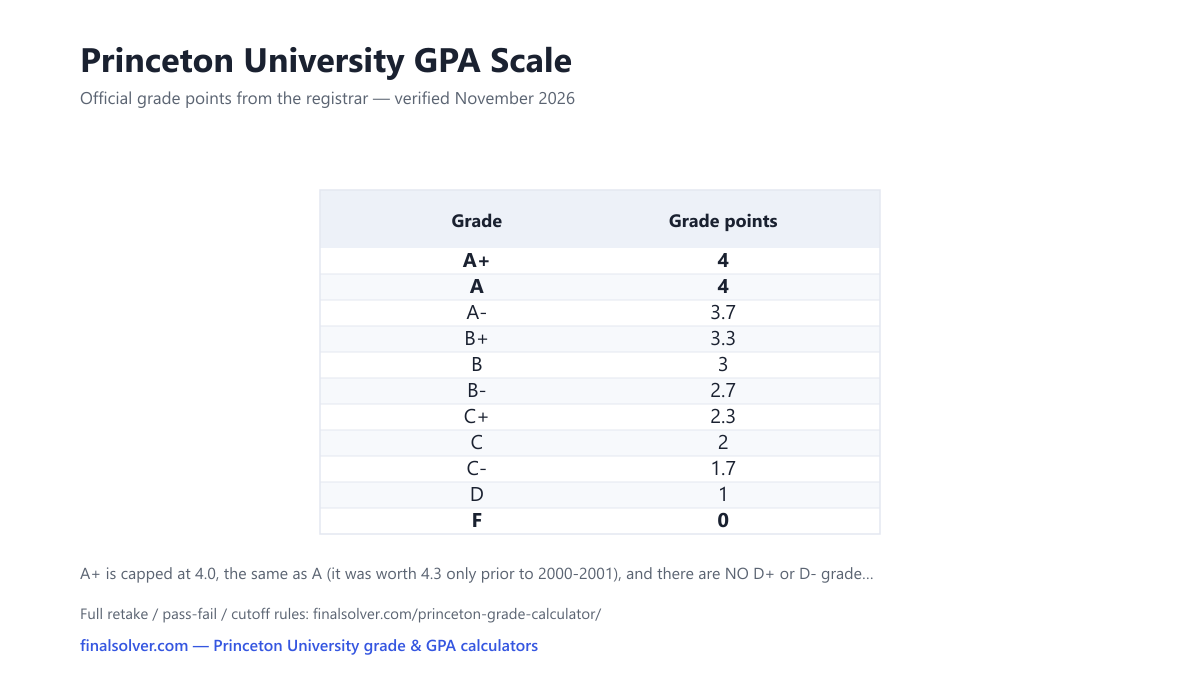
Princeton grading scale (official)
| Letter | Grade points |
|---|---|
| A+ | 4.00 |
| A | 4.00 |
| A- | 3.70 |
| B+ | 3.30 |
| B | 3.00 |
| B- | 2.70 |
| C+ | 2.30 |
| C | 2.00 |
| C- | 1.70 |
| D | 1.00 |
| F | 0.00 |
A+ is capped at 4.0 (the same as A — it was worth 4.3 only before 2000-01), and Princeton awards no D+ or D-: D at 1.0 is the lowest passing grade. Princeton does not officially compute or certify a GPA and keeps no class rank — the registrar publishes this scale for students who must self-report a number. P/D/F and audit courses are excluded from GPA. Princeton’s 2004–2018 grade-deflation policy (recommended A-range caps) was rescinded in 2018. Source: Princeton Registrar — Calculate Your GPA, checked 2026-11-11.
Failed-course retakes at Princeton: the F stays
A failed course may be retaken — sometimes it is required, for example to satisfy language or B.S.E. prerequisites — but the original F stays on the transcript and the retake grade is simply added alongside it. Repeating a course you already passed incurs a course deficiency, and both grades count. There is no grade replacement anywhere in the system.
So a Princeton retake is about meeting requirements, not GPA repair: the F remains in any average an outside party computes, and since Princeton certifies no GPA of its own, readers see the full transcript anyway. If a course is high-risk, the P/D/F election is the better tool — P/D/F work is excluded from GPA entirely (though departments limit how many P/D/F courses count toward requirements, so check before you elect it).
What do you need on your final?
Needed = (target − current × (1 − weight)) ÷ weight, where “weight” is your final’s share of the course grade as a decimal. Example: sitting at a 78% with a final worth 50% of the grade and wanting an 80% overall, you need (80 − 78 × 0.5) ÷ 0.5 = (80 − 39) ÷ 0.5 = 41 ÷ 0.5 = 82% on the final.
Princeton’s missing D+ and D- leave no cushion at the pass line: the fall from C- (1.7) to D (1.0) is a 0.7-point drop, and below D there is only F at 0.0 — a two-step cliff where most schools offer four grades.
Princeton University: GPA credits example
Princeton does not compute or certify a GPA and keeps no class rank — but when an outside form demands one, the registrar’s scale works like any credit-weighted average: (credits × grade points) summed ÷ total credits. Worked example on the Princeton scale: A (4) × 4 credits + A- (3.7) × 3 credits + B+ (3.3) × 3 credits = 37 points over 10 credits → GPA 3.70. The two Princeton signatures in the math: A+ adds nothing over A (both 4.0), and the ladder skips straight from C- (1.7) to D (1.0) — no D+ or D-. The calculator at the bottom of this page runs this exact table.
Three finals scenarios students actually ask
Static answers, checkable against the calculator above — the three setups that show up every December and May (pass line shown for a typical 70% D; your school's line is in the scale above):
| You sit at | Final worth | For a B− (80%) | To pass (70%) |
|---|---|---|---|
| 85% | 20% | 60% — makeable | 10% — already safe |
| 78% | 40% | 83% — study weekend | 58% — very makeable |
| 60% (bombed the midterm; 30% coursework at 100%) | 40% | 80% — a real but winnable fight | 55% — still passable |
Princeton University GPA calculator — official scale
Runs this school's exact grade-point table — not a generic 4.0 rounding.
Computed on this school's official grade-point table shown above — no rounding adjustments needed.
Frequently Asked Questions
Does Princeton calculate your GPA?
No. Princeton does not officially compute or certify a GPA and keeps no class rank; the registrar publishes the grade-point scale purely so students can self-report a number when an application requires one.
Does Princeton have D+ or D- grades?
No. D (1.0) is the only D and the lowest passing grade — the drop from C- at 1.7 to D at 1.0 is the biggest step on the scale, and below D sits only F.
Is an A+ worth 4.3 at Princeton?
Not anymore. A+ carried 4.3 only before 2000-01; today it is capped at 4.0, identical to an A.
Did Princeton grade deflation end?
Yes. The 2004 policy recommending A-range caps was rescinded in 2018, so departments no longer cap their share of A-range grades — the scale itself never changed, only the distribution targets.
Does a W look bad when I apply to grad school?
One or two Ws read as scheduling realism, not an ability signal — committees weigh trends and course rigor. A pattern of many Ws invites questions, and a W followed by retaking the course (and acing it) often tells a better story than the C you would have survived.
Can I retake a class I got a C in just to boost my GPA?
Not usually the door it looks like: at Princeton, passed courses are not repeated for grade improvement — so the C you survived is likely staying. Confirm the exact cutoff in the retake policy above before paying for anything; the cheaper move is usually banking a strong grade in your next course instead of re-buying one you already passed.