Colorado State University Grade Calculator
Colorado State prints its grade points to three decimals: an A- is 3.667, a B+ is 3.334, a C+ is 2.334 — and the scale is short, because C-, D+ and D- have not existed at CSU since Fall 2008. Type your current grade and final weight above to see exactly what you need.
Repeats at CSU count every grade by default; to drop the first one you must elect Repeat Repair (formerly Repeat Delete), capped at 3 courses / 12 credits for your entire undergraduate career — so spend it carefully.
Does your final have several parts (e.g. multiple choice + essay)? Enter each part, then your course info below.
Is your class graded by total points instead of percentages? Enter your points so far.
Enter each category's weight and your score in it. Leave a score blank if it's not graded yet.
🎓 Need your GPA instead? Jump to the Colorado State University GPA calculator (official scale) ↓
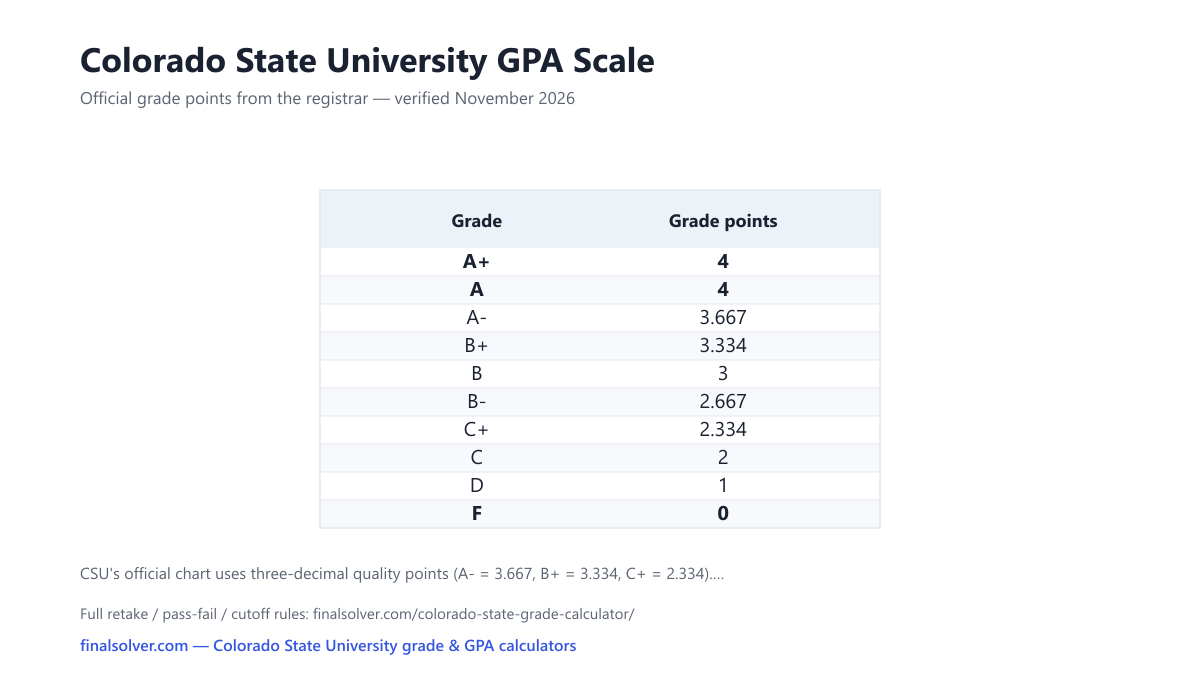
Colorado State grading scale (official)
| Letter | Quality points |
|---|---|
| A+ | 4.000 |
| A | 4.000 |
| A- | 3.667 |
| B+ | 3.334 |
| B | 3.000 |
| B- | 2.667 |
| C+ | 2.334 |
| C | 2.000 |
| D | 1.000 |
| F | 0.000 |
CSU’s official chart uses three-decimal quality points (A- = 3.667, B+ = 3.334, C+ = 2.334), not the rounded 3.7 / 3.3 shorthand — over 120 credits those slivers add up. An A+ earns the same 4.000 as an A, and C-, D+ and D- have not been valid grading options since Fall 2008 (Faculty Council action 1/31/2008), so the ladder drops from C (2.000) straight to D (1.000). Source: The Hub — GPA chart, checked 2026-11-11.
Repeat Repair: CSU’s 3-course cap
By default, all grades from repeated CSU courses count in your GPA — retaking a D and earning a B leaves both in the average. Undergraduates may instead elect Repeat Repair (formerly Repeat Delete): the first grade is dropped from the GPA and only the repair grade counts, while both attempts remain on the transcript. The cap is 3 courses / 12 credits for your whole undergraduate career (effective Spring 2014), the election must be requested the first time you repeat the course, and both attempts must be taken at CSU.
Strategy matters: with only three elections ever, most advisors say to save Repeat Repair for multi-credit courses where the first grade was an F or D. Anything repeated without an election simply averages both attempts into your GPA. Source: The Hub — Repeat Repair, checked 2026-11-11.
How the other camp does it: at Nebraska, replacement removes only earlier grades below C — the same retaken C yields a different GPA outcome entirely. Nebraska retake rules →
What do you need on your final?
Needed = (target − current × (1 − weight)) ÷ weight, with weight as your final’s share of the course grade in decimal form. Example: sitting at a 78% with a final worth 40% and a target of 80%, you need (80 − 78 × 0.6) ÷ 0.4 = (80 − 46.8) ÷ 0.4 = 33.2 ÷ 0.4 = 83% on the final.
CSU’s twist is the missing rungs: with no C-, D+ or D-, falling from a C (2.000) lands you on a D worth just 1.000 — a full point gone with no intermediate step — and since Fall 2008 there is no D- soft landing at 0.67 either. If you are near the C line, that final is worth a full grade point.
Colorado State University: GPA credits example
Your Colorado State University GPA is a credit-weighted average: (credits × grade points) summed ÷ total credits. Worked example on the official Colorado State University scale: A (4.000) × 3 credits + B+ (3.334) × 4 credits + A- (3.667) × 3 credits = 36.337 points over 10 credits → GPA 3.63. CSU keeps three-decimal quality points (A- 3.667, B+ 3.334, B- 2.667, C+ 2.334), tops out at A = A+ = 4.000, and has awarded no C-, D+ or D- since Fall 2008. The calculator at the bottom of this page runs this exact table.
Three finals scenarios students actually ask
Static answers, checkable against the calculator above — the three setups that show up every December and May (pass line shown for a typical 70% D; your school's line is in the scale above):
| You sit at | Final worth | For a B− (80%) | To pass (70%) |
|---|---|---|---|
| 85% | 20% | 60% — makeable | 10% — already safe |
| 78% | 40% | 83% — study weekend | 58% — very makeable |
| 60% (bombed the midterm; 30% coursework at 100%) | 40% | 80% — a real but winnable fight | 55% — still passable |
Colorado State University GPA calculator — official scale
Runs this school's exact grade-point table — not a generic 4.0 rounding.
Computed on this school's official grade-point table shown above — no rounding adjustments needed.
Frequently Asked Questions
Why does CSU list A- as 3.667 instead of 3.67?
CSU’s official chart uses exact thirds printed to three decimals: A- 3.667, B+ 3.334, B- 2.667, C+ 2.334. Computing your GPA on the rounded 3.7 / 3.3 numbers most generic calculators use can drift it by a hundredth or two — this page uses CSU’s exact values.
Does CSU have C-, D+ or D- grades?
No. The Faculty Council removed C-, D+ and D- effective with Fall 2008 grading (action dated 1/31/2008). The scale steps from C (2.000) directly down to D (1.000), then F (0.000).
Can I replace a grade at Colorado State?
Only by electing Repeat Repair (formerly Repeat Delete) when you first repeat the course: the original grade leaves the GPA, both attempts stay on the transcript, and both must be taken at CSU. Without the election every grade counts. The lifetime cap is 3 courses / 12 credits.
What GPA is an A at CSU?
An A is 4.000 quality points, and an A+ earns the same 4.000 — there is no bonus above 4.0. From there: A- 3.667, B+ 3.334, B 3.000, B- 2.667, C+ 2.334, C 2.000, D 1.000, F 0.000.
Does a W look bad when I apply to grad school?
One or two Ws read as scheduling realism, not an ability signal — committees weigh trends and course rigor. A pattern of many Ws invites questions, and a W followed by retaking the course (and acing it) often tells a better story than the C you would have survived.
Can I retake a class I got a C in just to boost my GPA?
You can, but run the numbers first: at Colorado State, all repeated grades count unless Repeat Repair is elected. A C retaken for an A pulls the GPA weight of that course to roughly the midpoint — a real but partial gain, rarely worth full tuition. Check the policy above for any forgiveness carve-out before deciding.