Boston University Grade Calculator
BU's official honor-point scale has two unusual gaps: there is no A+ (A tops out at 4.0) and no D+ or D- — the table runs A 4.0, A- 3.7, B+ 3.3 ... C- 1.7, then jumps straight to D 1.0 and F 0.0. Plug in your current grade and final weight above to see what you need.
BU also has no grade replacement: repeating a course puts every attempt into your GPA, and Pass/Fail works backwards from most schools — you elect it near the end of the course, capped at 8 units. Details below.
Does your final have several parts (e.g. multiple choice + essay)? Enter each part, then your course info below.
Is your class graded by total points instead of percentages? Enter your points so far.
Enter each category's weight and your score in it. Leave a score blank if it's not graded yet.
🎓 Need your GPA instead? Jump to the Boston University GPA calculator (official scale) ↓
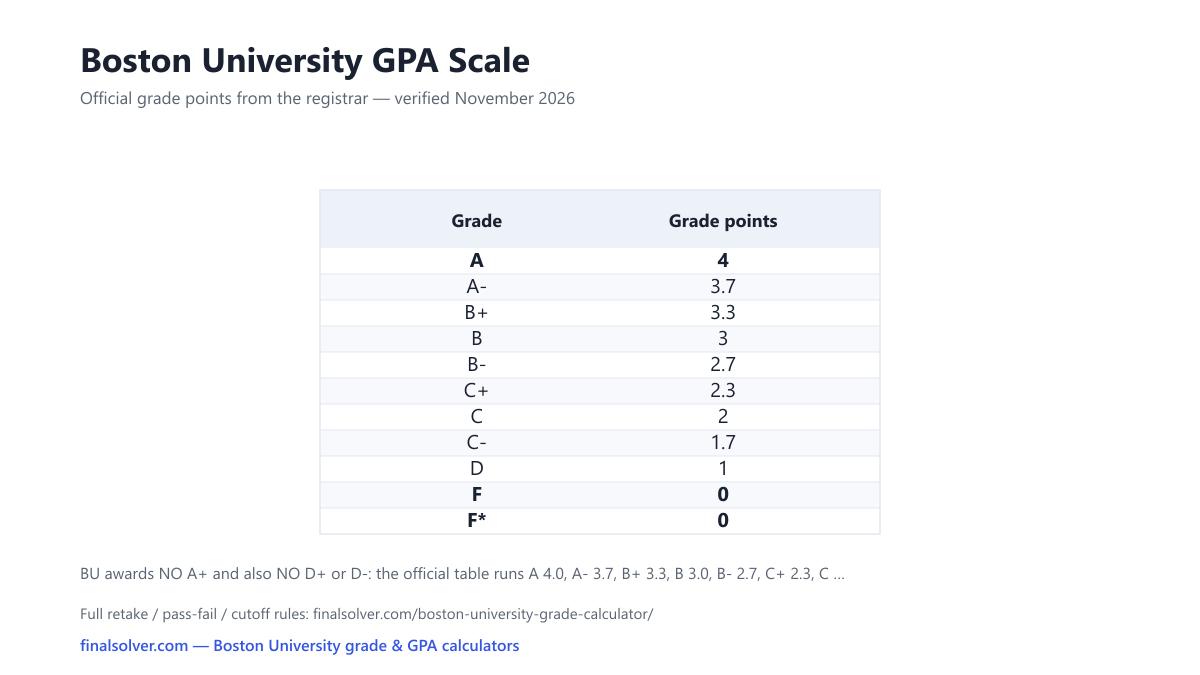
Boston University grading scale (official)
| Letter | Honor points |
|---|---|
| A | 4.0 |
| A- | 3.7 |
| B+ | 3.3 |
| B | 3.0 |
| B- | 2.7 |
| C+ | 2.3 |
| C | 2.0 |
| C- | 1.7 |
| D | 1.0 |
| F | 0.0 |
| F* | 0.0 |
No A+, no D+, no D- — that is BU's entire letter range, and the points are one-decimal steps (3.7/3.3, never 3.67). F* means a fail in a course you elected Pass/Fail; it carries 0.0 honor points like an F, while P*, AU, CR, NC, P, W and MG carry no honor points at all, and I/J grades stay out of your GPA only until they are resolved. BU publishes no official percentage cutoffs — every percent-to-letter table lives in an instructor's syllabus. Source: BU Office of the University Registrar — Grades & GPA, checked 2026-11-01.
Repeating courses and Pass/Fail at BU
BU has no grade replacement. Under the Repeated Courses policy, "all of the units and grades earned are included in the calculation of the student's grade point average" — the repeated grade does not replace the original. A non-repeatable course can be taken again for a grade only once, and units count toward the degree only once (take a 4-unit course twice, you get 4 units, not 8).
Pass/Fail is capped at eight units total, with one P/F course per term, and you designate it near the end of the course — the deadline is the course's drop-with-a-W date, after which the choice is irrevocable. A D or above becomes P*: units count toward the degree but nothing enters your GPA. An F becomes F*: both units and grade ARE computed in your GPA and the units do not count toward the degree. For students entering as first-years in fall 2018+ (transfers fall 2020+), P* cannot satisfy college/school, major, or minor requirements.
What do you need on your final?
Needed = (target − current × (1 − weight)) ÷ weight, with weight as the final's share written as a decimal. Example: you are at an 80, the final is 25% of the grade, and you want an 83: (83 − 80 × 0.75) ÷ 0.25 = (83 − 60) ÷ 0.25 = 23 ÷ 0.25 = 92.0%. Crossing the C-/B- style thresholds matters more at BU than nudging inside a band, because there are no D+ or D- rungs — from C- (1.7) the next stop down is D at 1.0, a 0.7-point drop in one step.
Boston University: GPA credits example
Your Boston University GPA is a credit-weighted average: (credits × grade points) summed ÷ total credits. Worked example on the official Boston University scale: A (4) × 3 credits + B+ (3.3) × 4 credits + A- (3.7) × 3 credits = 36.3 points over 10 credits → GPA 3.63. BU awards NO A+ and also NO D+ or D-: the official table runs A 4.0, A- 3.7, B+ 3.3, B 3.0, B- 2.7, C+ 2.3, C 2.0, C- 1.7, then jumps straight to D 1.0 and F 0.0 (one-decimal steps, never 3.67). The calculator at the bottom of this page runs this exact table.
Three finals scenarios students actually ask
Static answers, checkable against the calculator above — the three setups that show up every December and May (pass line shown for a typical 70% D; your school's line is in the scale above):
| You sit at | Final worth | For a B− (80%) | To pass (70%) |
|---|---|---|---|
| 85% | 20% | 60% — makeable | 10% — already safe |
| 78% | 40% | 83% — study weekend | 58% — very makeable |
| 60% (bombed the midterm; 30% coursework at 100%) | 40% | 80% — a real but winnable fight | 55% — still passable |
Boston University GPA calculator — official scale
Runs this school's exact grade-point table — not a generic 4.0 rounding.
Computed on this school's official grade-point table shown above — no rounding adjustments needed.
Frequently Asked Questions
Why does BU have no A+ or D+ and D- grades?
Boston University's official honor-point table simply stops at A (4.0) on top and skips from C- (1.7) to D (1.0) at the bottom, so those three letters are never assigned. The practical effect: an A is the GPA ceiling, and the space between 1.7 and 1.0 is one big step.
Can I replace a grade at Boston University?
No. BU's Repeated Courses policy states all units and grades from every attempt are included in your GPA and "the grade for the repeated course does not replace the original grade." You can retake a non-repeatable course for a grade only once, and units count toward the degree only once.
What GPA is an A at BU?
An A is worth 4.0 honor points — BU's term for grade points. A- is 3.7, B+ is 3.3, B is 3.0, B- is 2.7, C+ is 2.3, C is 2.0, C- is 1.7, D is 1.0, and F (or F*) is 0.0.
Does Boston University round grades?
BU publishes no university-wide rounding rule. Instructors must submit letter grades within 72 hours of the final exam, and any percentage-to-letter conversion or rounding is set in each course's syllabus.
How does pass/fail work at BU?
You may elect up to 8 units total Pass/Fail, one course per term, and you make the election near the END of the course by the drop-with-W deadline — it is irrevocable after that. A D or better becomes P* (units count, GPA untouched); an F becomes F* (units and grade both hit your GPA).
Can I use the GPA calculator on this site for BU?
Yes — the calculator on this page runs Boston University's official grade-point table exactly. Weight credits as shown in the "GPA: how the points add up" section below; the general calculator elsewhere on the site uses standard rounding if you ever need a plain 4.0 number.
Does a W look bad when I apply to grad school?
One or two Ws read as scheduling realism, not an ability signal — committees weigh trends and course rigor. A pattern of many Ws invites questions, and a W followed by retaking the course (and acing it) often tells a better story than the C you would have survived.
Can I retake a class I got a C in just to boost my GPA?
The math flips completely depending on whether Boston University replaces the old grade or averages both in — check the retake policy above before paying for the credits. Many schools also bar retaking a course you already passed; that policy is above too.
More calculators
Compare with other schools
Grading rules vary wildly — Boston University vs other schools with different systems: